Archive | Uncategorized RSS feed for this section

Area Woman Discovers Camping, A Love Story

11 Nov

Outsidey, not Outdoorsey

I don’t come from a camping family. My dad was in the navy, and loves a good Weber grill. However “hardy”, “outdoorsy” – these aren’t words that come to mind when I think of him. My mom’s dad liked to fish; his son (Peter) also loved to spend time outdoors, boating, fishing, camping. I don’t really know why my mom didn’t cotton on to this the same way. Given the era she grew up in, I don’t know if she was invited or encouraged to spend as much time outdoors as her brother, but I would guess she also likely didn’t have a ton of innate interest in it.

So it makes sense that we weren’t a camping family. We spent a fair amount of time outdoors – on long bike rides along the Sacramento River; hiking on summer road trips; whole days spent at the beach or the river while on vacation. As a kid, I would take any opportunity to put my body in water. I would swim in the coldest oceans on cloudy days and my family always had to cajole me to get out so we could get going on to the next thing. But outside of those bike rides and beach days, I mostly remember my time spent outdoors as involving a lot of meandering, sitting, and watching.

Dad was often working and unable to join us for vacations, so we would go to visit Nana and then bring her along on trips to Monterey or Mendocino. My mom loves the ocean and instilled that love into her kids as well through these frequent trips, mostly up and down the California coastline. Although she also loves to walk along the beach and hunt for shells in the surf, one of her favorite things, still, is to find a good spot – on the beach or high up above – and just plant herself for awhile. Maybe she has a book, but mostly she’ll just sit and watch and listen to the ocean, maybe close her eyes for a bit and feel the sea spray or wind flying onto her face. She loved this at 40 (and probably at 20) just as much as she loves it at 70 and this, coupled with often having Nana in tow, meant good chunks of our coastal vacations were spent whiled away on the beach or on a cliff overlooking the ocean. Or we would visit botanical gardens or missions and stroll slowly through the grounds.

In this way, it wouldn’t be correct to say I haven’t always, on some level, appreciated the outdoors. I, too, love being near the ocean and that never waned as I grew up. But I’ve learned to appreciate the hills and the forest, too, and now I spend more time moving through (and deeper into) nature, rather than just observing it from a remove.

In the Pacific Northwest particularly, it’s easy to feel like it’s a contest and that the less active you are the less real your love of nature is. For too long this played a part in stopping me both from getting out there and from considering myself a nature lover. ‘How could I love nature if I couldn’t withstand a 5 mile hike?’ I asked myself. I see clearly now how absolutely unrelated those two things are.

A Poor Start

I have a vivid memory of the first time I tried to go hiking with friends as an adult. In retrospect, this venture was doomed from the start in many ways. It was early spring, maybe March or April, and we were headed to an area with some elevation – I didn’t know then, but quickly learned, that this could mean some snow still on the ground in the upper reaches of the hike. We were all in our early 20s, freshly graduated from college – the hike was, for me, an attempt to bond with some new friends from my Americorps cohort after a recent move to a new city. They were all going hiking, they invited me, and I didn’t want to be left out of this still newly forming group – I didn’t want to miss anything important.

Having never really hiked, I was under prepared. I didn’t have the right shoes, I seem to remember I may have been wearing jeans. I think I did bring a water bottle, but not much else. I was one of the drivers that day and I remember a slight sense of unease as I picked people up – it seemed like every one else had a backpack and snacks, some people had an extra pair of shoes (hiking boots), one person even brought hiking poles. I was out of my depth. Now, I don’t really blame my fellow hikers – we were all young and they were all fit. I think it was nice that they didn’t look at my oversized frame and presume I couldn’t handle it. By dent of doing an Americorps stint, we were all smart, capable, kind, young people, but I think also by the same logic, we were all naive. No one questioned whether anyone else was up for it, everyone presumed we all knew what we were doing and were equally comfortable. I had a personal responsibility to flag if I couldn’t hack it (or just not to join in the first place), but I didn’t know enough to know what I didn’t know.

I made it about half way up the hike and had been struggling the whole way. I kept falling behind the group and one of the other hikers, Megan, very kindly slowed her own pace to stay with me. Several of the hikers would loop back to check on us as we made our way along and then they would disappear ahead again as they easily caught back up with the group. I felt deep shame and embarassment the entire way, but Megan kept up a steady conversation and helped alternately distract and encourage me.

I finally reached the rest of the group at a spot where they were taking an extended break and deciding what to do next. At this point in the trail, we were starting to encounter snow. I was so relieved to catch up and take a break, but (predictably) just as I was arriving they were ready to set out again. They decided to keep going at least a bit further – the snow wasn’t deep, most people had the right gear or just were willing to make do. I couldn’t do it, I wasn’t willing to do it. I told everyone I was going to turn back and head down to the car and wait. Everyone, kindly, protested, and tried to encourage me – “it won’t be that bad”, “you can do it”, “we want you with us” – I don’t remember the exact words, though that was the gist. But I held firm, I knew my limits and they’d already been exceeded. So we split up, Megan initially tried to come down with me, but I insisted she get some time with the group and join them instead, she had already done so much for me. Frankly, I also just wanted to be alone. I needed space to really feel bad.

I walked back down the trail alone, cold, somewhat wet, and just feeling deeply ashamed, beating myself up and wishing I was stronger, fitter, thinner; or had been smart enough to know not to come in the first place. I remember arriving at the car, getting inside and turning the heat on, and just sitting in the driver’s seat, crying. It would be 7 years before I hiked again.

A Gentle Re-entry

Over the last 11 years, I’ve remembered I like to be outside and figured out I like to hike, too. I almost entirely credit my husband, Kendall, for this. We started dating in late Spring 2014 and within a month Kendall had taken me on a (flat) walk along Trillium Lake with some friends of his as a sort of double date. He didn’t do plan it this way on purpose, but it was literally the perfect way to get me back out there. This wasn’t the first time I was meeting Alex & Lulu, but it was the first time I was really spending a chunk of time with them. I felt some pressure to be on my best behavior and give a good impression, but in a way that made me eager to please and ready to be flexible, rather than making me anxious, which was lucky. They had a small child in tow (I wanna say Max was 3 or 4 at the time), the trail is a loop around the lake under 2 miles, with no elevation gain. We stopped constantly – for Max to look at an old log, to stop and watch a spider build his web, to look at the Trillium flowers blooming at the edges of the trail. I never got tired and had a wonderful time.
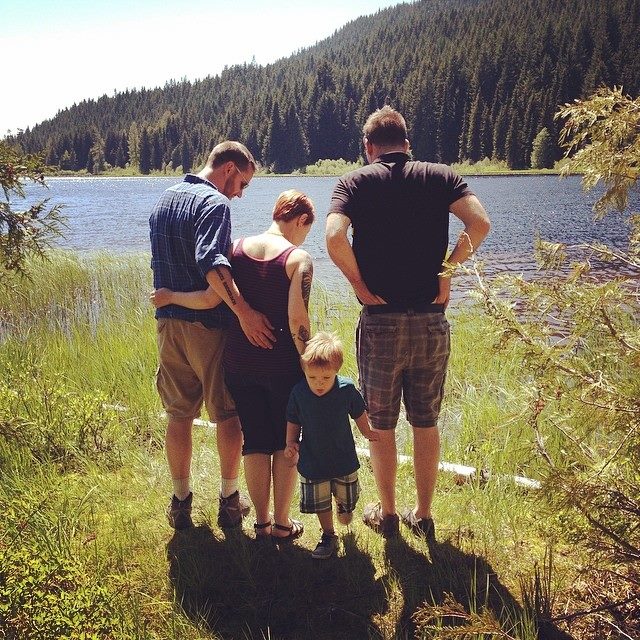
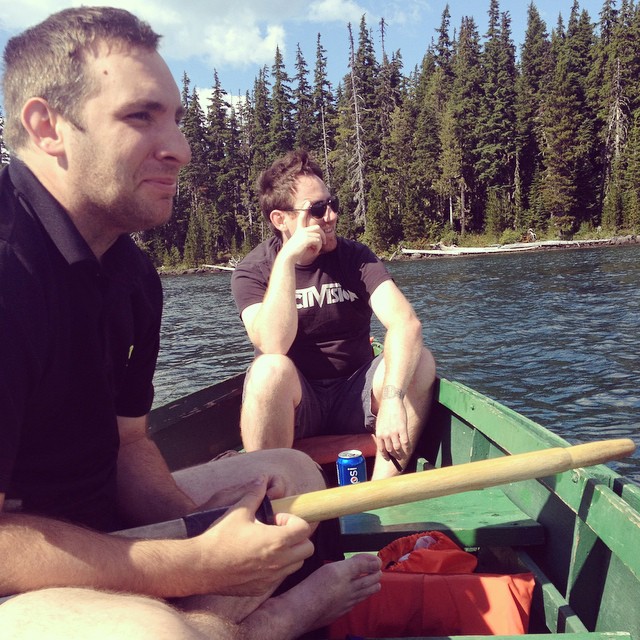
After this, Kendall and I were constantly outside and going on hikes or walks those first several years. I remember paddling on Olallie Lake with another of Kendall’s dear friends, Tom. It was my first time in a boat probably since I was a child in Uncle Peter’s boat, fishing somewhere in or near the Rogue River. A lot of things I did with Kendall outside were like this, they felt like familiar echoes of things I hadn’t thought of in 20 or 30 years, like deja Vu sometimes.
From the beginning, Kendall has been the ideal hiking partner. I told him my formative hiking story and on some of our first more strenuous hikes he saw how I struggled both physically and mentally. He has always been encouraging in a way that doesn’t feel infantilizing or pitying, and he’s good at finding the moment to say the hard, true thing that will help you. We take as many breaks as I want and he never (intentionally) makes me feel rushed, like I’m going too slow or taking too long. Usually when I sense that he’s impatient and say so, it ends up just being me anxious that he’s impatient, rather than him actually being impatient. I feel safe out there with him. He’ll never leave me behind/go on ahead, he’s good at reading trail maps and figuring out confusing or unmarked trails, and as a bonus he gets both more philosophical and more gentle while we’re out on hikes. He’s both these things already/at home, but the grind of every day life means you glimpse it less on the couch than out in the woods. I love being in the woods or on a cliff or behind a waterfall with Kendall.
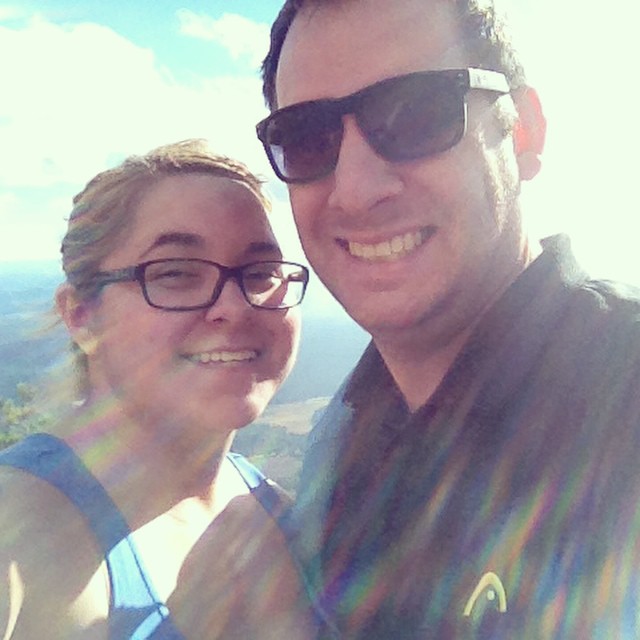
He’s been there for all my hardest hikes (well, he’s been there for almost all my hikes. I think I’ve done maybe two solo over this last decade and have taken my mom out a few times). He’s had to talk me down off the ledge (figuratively and literally) when I’ve been sure I couldn’t do it (but did). He’s had to calm and soothe me when I really couldn’t do it and all those old emotions come rushing back.

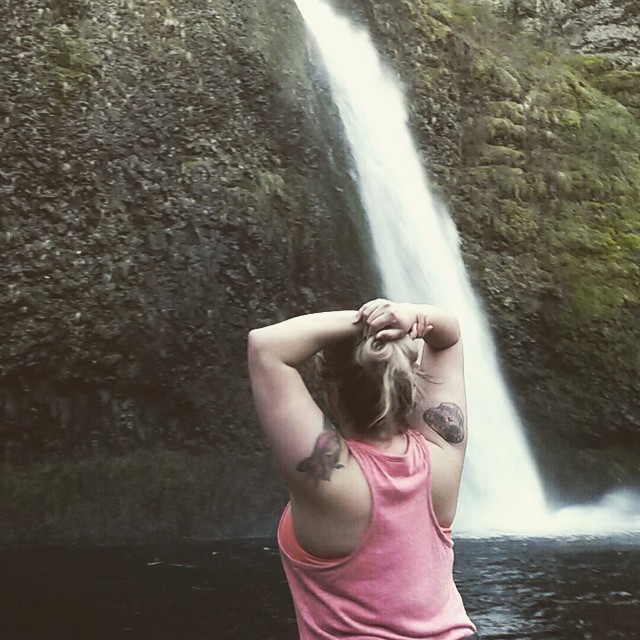
However, I’ve felt pretty down about how little I’ve hiked over the past couple years. We hiked a lot those first few years we were together, and before we lived together it was a great way to spend a whole day together. After we moved in, we got a cat, I at one point was working 3 jobs, and we just stayed home more. As you do in a relationship, we got more comfortable, and we got fat (fatter) together. Then the pandemic hit. Lots of people flocked to the outdoors during that time, but we mostly hunkered down. Every year we’ve been together, we’ve spent time outdoors, but it’s been less frequent of late and I’ve been itching to get out there more.

Kendall spent most of this spring hiking pretty constantly, solo, getting in shape for a planned backpack in July. I could have joined for some of these prep hikes, but for the most part he was doing somewhat strenuous hikes with elevation gain and/or mileage, and I also usually just didn’t feel up for it anyway.

As a total aside, I am constantly torn between the desire to get outdoors and the desire to sleep in. Hikes, while not exclusively for morning people, seem to be designed for them. As I’ve become more comfortable hiking (and also just more comfortable in my own skin and more willing to advocate for myself), I’ve been wanting to start hiking with other people again, but most people who like to hike want to be leaving the trail by 3pm, not just starting out. However, at least in summer when the sun sets at 9pm, I’ve found that a late start works almost as well as an early start for avoiding busy times on the trail.

As we were doing all that avid hiking early on in our relationship, Kendall broached the topic of camping. I initially was wary, to say the least. I think of myself as the living embodiment of “I’m outsidey, not outdoorsy”. Even as my love for hiking and being outdoors has grown, I’ve continued to draw some lines in the sand. I like to pee inside, thanks. Preferably with running water and flush toilets, but a pit/vault toilet will work in a pinch. I don’t like going more than a day without a shower. These things alone are prohibitive for tent camping, at least for very long, but I also had no experience camping and therefore, no gear. Kendall had some gear, but he also had not used it in some time. Nonetheless, a couple years in we tried a single night of camping, for a friend’s wedding.

A Trial Run

The wedding seemed like a good moment to do a camping trial run. There were bathrooms, first of all, so that part was easy. It was a wedding & reception with after party and we would likely not be doing much other than sleeping in the tent – we didn’t need to set up a full camp, plan meals, or spend lots of time there, it was only 1 night. Unfortunately, it rained cats & dogs while we were there. This started in earnest during the couples’ first dance and they embraced it, getting soaked in the process – it was a beautiful moment. The party went on and over the next few hours we all alternately spent time on the lawn (or in the lake!) or on the dock when the rain let up, and then huddled under the event tents when the sky opened up once more.

Kendall had set our tent up before the wedding started, when we finally crawled in late at night it was still raining pretty hard and parts of the tent were a little damp, but it seemed mostly serviceable. I fell asleep cold and uncomfortable, but luckily just tipsy & tired enough to not really mind too much. Within an hour or two, we both woke up in a puddle. As the rain had continued, the ground underneath had become muddy, the tent flooded. I woke up wet and miserable, and to find some of my clothes stored in the corner of the tent soaked through. After a moment’s consideration, Kendall bundled me into the car and began to break down the tent in the now torrential downpour. We left sometime between 3-4am and began the hour or so’s drive back into Portland, sleepy but fully sobered up by the ordeal.

I knew that night was a fluke. Kendall’s tent turned out to be less than ideal and may have had a hole in it – in any event, he threw it out upon our return. It wasn’t originally forecast to rain like that, and it just was relentless. Even a high quality tent without a hole in it would’ve struggled to keep someone completely dry in those conditions. Our camping spot wasn’t entirely flat and the small ditch underneath us contributed to the water pooling up the way it did. But it had been so miserable and I had already been skeptical, so that little foray into camping pretty much extinguished any even dawning or slight desire I had to spend the night outside, for a good long while (about 10 years).

Kendall’s backpacking trip this summer didn’t go as planned. He ended up needing to cut it short & return home early, but just being out there for one night (well, and all the prep and planning and gear he had bought in advance) reignited the desire in him to try again (and to try again to convince me lol). Fortunately, in the intervening years since that ill-fated “camping trip”, I’ve softened towards it. I’ve also made several friends since then who love to camp & backpack and do both, often. Hearing their stories, seeing Kendall’s adventures, and yearning to find ways to get outside more, I finally felt ready & even eager to try it again, too.

A Better Trial Run

We had started to plan our annual Fall vacation and had been struggling with how to be on the road as long as possible without spending all of our money. I remembered a place my family stayed when I was a kid, on one of those many coastal vacations. We stayed in rustic cabins and I initially looked at those, but they were basically the same price as a hotel. However, the property also had tent camping sites and a generous cancellation policy. Kendall had also planned another “trial run” camping trip for September, in Cottonwood Canyon, where he has camped before. We figured if that was a disaster, we could pivot and change our October camping plans, too – so we booked the site.

Now that Kendall had recently upgraded his gear, he largely had us covered. I just needed to figure out some basics – a sleeping bag and pad, at least. I went to a local outdoor shop where they sell both new and used gear. I walked in and was immediately greeted by a friend, who I didn’t even know worked there – it felt like a good omen. I explained to Shorty that I wanted to get gear that was comfortable enough for me not to hate it but also wasn’t, like, top of the line or super expensive – because this could be potentially the only time I use it. An enthusiastic camper and backpacker himself, he basically said ‘say no more’ and helped me find the perfect sleeping bag and pad, explaining as we went the benefits of X vs. Y and helping me make good decisions with his no-bullshit advice. I left both literally and figuratively better equipped for our camping trip, getting more excited to go.

And camping at Cottonwood Canyon went great! We only did one night and while it was windy when we first arrived and set up camp, the wind died down in the evening and the stars were out in full force.

I had trouble sleeping, but that was unsurprising – I always have trouble sleeping, and being in an unfamiliar place, sleeping in a tent, not having my usual sleep aids all contributed to a somewhat fitful night. But each time I awoke, there were stars up above, or coyotes (or wolves?) howling in the (alarmingly close) distance, I could feel a light breeze whispering through the tent, and Kendall was there right beside me (fast asleep lol) – it was magical. I also learned a lot, about what I really need and what I don’t, what to bring next time and what to leave at home, what worked to share with Kendall and what I wanted to have of my own.
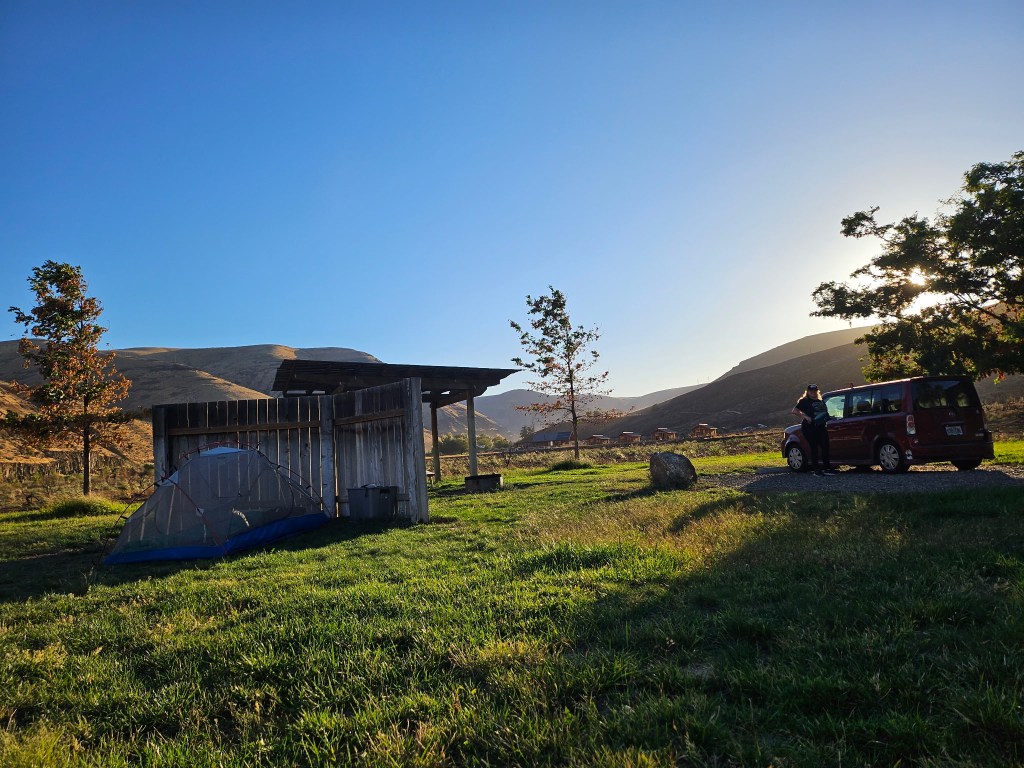
We generally love to travel during the Fall shoulder season and we got married during this time of year partly so we’d always have a good excuse to disappear for awhile in the autumn. However, camping, at the Northern California coast, in Fall, was a bit of a risk. Cottonwood Canyon is high desert – it had been windy, but dry. We didn’t even use the rain fly. As we got closer to our Fall travel dates, we checked the weather constantly. It initially looked like it would be dry, but cold. Then in the days before we left, it shifted – there would definitely be some rain passing through, but it seemed like the worst of it would be happening the day we left. Kendall assured me his newer gear was up to the task if it did rain. Additionally, our campsite was under a canopy of trees, which would help shield us from the rain somewhat. Finally, we figured if it really got bad we could improvise on the fly – sleep in the car or make the call to find a hotel. The nice thing about how we planned this was that the camping was occuring the first two days of our road trip – so I had the attitude that even if it went badly, it was just two nights and we were in hotels the rest of the trip.

The Real Test

We arrived in Trinidad around 4pm the day of check-in. We got to our site, which we had selected online just based on a property map, and realized it was closer to the road, more exposed, and just less flat than we would have liked. The benefit of it being October and these being tent sites is that practically all of the sites around us were unoccupied. We walked through them and selected our favorite then went back to front desk to confirm it was okay for us to move – they updated our parking & site tags with the new site number and we proceeded to set up camp. Or, rather, Kendall proceeded to set up camp. I helped a little when it was just easier to have 4 hands rather than 2, but he did most of it.

I’ve discovered that an unforeseen perk of camping for me is getting princess treatment. I love to get princess treatment – I really think this is not a female thing, I think all people love to get princess treatment from time to time. Being a novice in a situation is a great way to get princess treatment and I don’t know how long this will last if we keep camping, but I intend on forever.
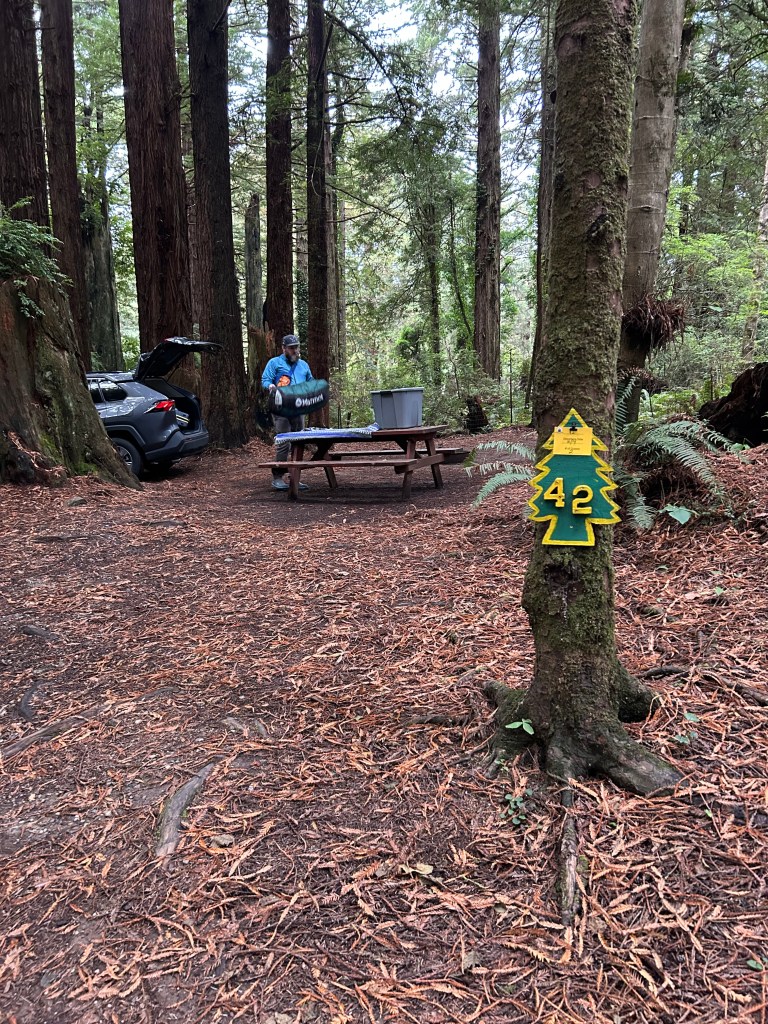
Knowing it may rain, we set up a second tent so we’d have somewhere a bit more spacious to hang out and play cards, etc. if we couldn’t just post up at the picnic table. After we set up camp, we went and checked out the bathhouses and the rest of the property, and then took the car into town to grab dinner, and a few more snacks at the grocery store.

Both times we’ve camped now we opted to either bring prepared food or plan to dine out. Part of this is because of the fire bans that have been ongoing, but Kendall has a propane burner (allowed) and we *could* have done some basic meal prep had we so chosen. We did use his burner to boil water for coffee in the morning (and also a half-ass attempt at s’mores). I am uninterested in freeze-dried food and the like and there’s really no need to do that when you’re not backpacking. But also, these being my first real forays into camping, and me being pretty intense about food in general, I think we both just thought it would be best to make that a non-factor for now. In future I would like to explore more camp cooking, but it will likely look more like prepping meals at home to be heated up over a campfire or burner. In general, I’m interested in taking less, not more, gear along and bringing prepared foods or dining out seems to help a lot with that. When we went to Cottonwood, we got deli sandwiches on the way in that afternoon and ate them that evening. At Trinidad, we just went out to eat both nights – pizza the first night, Mexican food the second. (It also, was, vacation after all).

We got back to our campsite the first night and it had started raining, but not too hard. We sat in our ‘living room’ tent and played a couple games of Skip-Bo before crawling into bed sometime after 11. Kendall, as usual, fell right to sleep. This time, I had thought to bring (and charge) my headphones, so I fell asleep listening to my audiobook. A couple hours later I woke up to much harder rain. The sound was lovely and, so far, I wasn’t getting wet. I drifted in and out of sleep over the next few hours – fat rain drops plopping down pleasantly overhead. It was, once again, magical.

Sometime around 6am, I was awoken more rudely by the tiniest splish splashes through the rain fly. It had been raining so persistently for so long that the water was finally making the tiniest dent through the tent. This was still miles away from that first rainy “camping” experience. It was dry underneath & around us, no puddles, no soaked clothes. Just the occasional drop eking it’s way through. Still, as the morning wore on and the sun started to rise, these miniscule drops nonetheless started to feel like some sort of very mild torture. It was the unpredictability of it, there’d be nothing for 10 minutes then all of a sudden a raindrop in your eye or the feeling that someone with a lisp said ‘sassafras’ a little too close to your face. Kendall started to stir. We both had to pee. It was a bit before 8am and time to start the day.

One thing camping will do is get you up early. The sun rises and there’s no blackout curtain; the forest wakes up around you, but if you’re at a camping resort like we were, the resort itself also wakes up. When we got up that morning, it was pouring. We made a run for the bathrooms, got ready to start the day, then zoomed out of there. One thing I was not sure about re: camping was the activities that go alongside it. As was well covered above, I like to hike now. But the idea of hiking and then not showering and then sleeping in close proximity to my husband who had also hiked and not showered was…not appealing to me.

When we went to Cottonwood, we arrived later in the afternoon and didn’t have time to get a hike in before the sunset. We ended up hiking the next morning before leaving. It was a pretty warm day and when we got to the river, I nearly jumped in – not just to cool down, but just the thought of rinsing off right then was tempting. Because Cottonwood was just one night, we opted not to shower that evening or the next morning, even though there were facilities available. So I was already gross when we started hiking and then got grosser, and then we still had to drive home. We both made use of some body wipes so as to feel slightly fresher for the ride home (and that became Item No. 1 for me to get my own for next time).

At Trinidad, the showers were coin-op. I had enough cash to buy us each 1 short-ish shower, and there was some discussion about when we were each going to use that. I initially had planned to wait to shower until we were leaving the next day, so I would be fresh for the 4 hour road trip to our next location and whatever we decided to do along the way. But I didn’t know if I could make it through a planned day of hiking and exploring to dinner out and sleeping in a tent again without another shower. The rain kept our explorations indoors for the first hour or two of the day – to a coffee shop for some breakfast, to a gift store nearby, running an errand to find more batteries for one of our lanterns – but then it let up enough for us to get outside. We spent the day exploring the redwoods and the coastline.

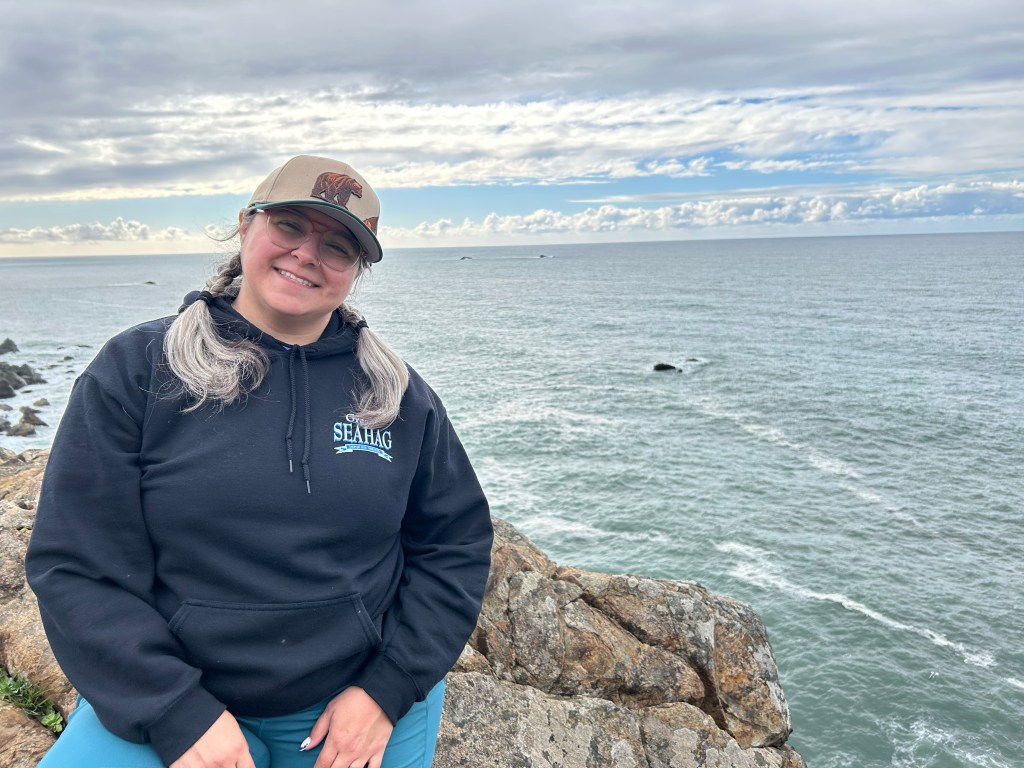
We then returned to camp with plans to go seek out dinner and maybe a brewery. At this point Kendall declared his own intention to shower and so I did the same. It was absolutely the right choice. We were fresh and clean for dinner & beers & bed. Although the tent itself was still a bit wet from the previous day, it didn’t rain again that night and we slept comfortably, though I actually missed the sound of the rainfall. The next morning, we made coffee and ate some store-bought pastries, then Kendall packed us up and we got on our way to continue the rest of our roadtrip.

Reflections on Camping

From the night at Cottonwood, I learned more about what to bring, what I still needed to purchase (mostly just base layers). From our time camping at Trinidad, we figured out a bit more about how we want to set up camp in future, and I learned that camping in the rain can be fun, so long as you don’t get soaked. We talked a lot about what we want to try in future, and I’ll pack my bag a little different next time, too (and probably the time after that, and the time after that, until I get it down).

Overall, I’ve learned that there are no rules, or rather that camping can be whatever you want it to be. I always thought it *had* to be really stripped down and basic, that you had to “rough it” for it to “count”. While I understand the sort of debate that people can have about whether or not glamping is camping and what lines you cross when you incorporate water or electrical hook-ups, for example, I’m also not really interested in that conversation. I think you should do whatever makes you comfortable out there, so long as it doesn’t disturb or disrupt other campers, or take away from the intention & experience of being out in nature.

There are choices we’ve made camping so far that others wouldn’t; there are things I’ve decided are dealbreakers for me that wouldn’t be for others. There are ways I’m going to camp, and ways I’m not. I no longer feel the need to prove anything, I just want to find ways to get out there and not to torture myself while doing so.

Which is funny because that’s sort of where I’ve landed with hiking after all these years, too – I no longer feel the need to prove anything, I just want to find ways to get out there and not to torture myself while doing so.

Near the end of our road trip, on one of our last days near Shasta, Kendall and I did a 3-ish mile hike with some elevation gain. I had to take more breaks than I maybe would’ve liked. During one of these breaks, I said something about this to Kendall – how I was out of shape and hadn’t been hiking enough this past year – and he said “yeah, but you’re mentally tougher than you used to be, which makes a big difference”.

Progress isn’t always linear, but this was also a good reminder that the mental toughness you gain doesn’t really go away the same way your lung capacity or leg strength can. Hiking, and now camping, both make me feel more capable. And that’s still true, even if I bring a sub sandwich along, or have to camp near a bathroom, or need a shower after a day and a half, or take a lot of breaks while hiking.

Accidentally Ideal Chicken Soup

21 Dec

Before I dive in to this recipe, I feel it incumbent upon me to acknowledge that I only post here like once a year at this point haha. I just within the last few months took on a new job and quit my old one and for the first time in a long time, I’m only working part-time (mostly). So I hope to have much more time and energy to devote to things like cooking and writing blog posts (and just writing more again, in general), but time will tell. If 2020 has taught me anything, it’s not to make assumptions about the future.
Because I’m a big believer in not having to read someone’s whole life story before getting to the recipe, it’s right up top – but if you’d like to read more about how I developed this, there’s more on that below the recipe.

Emi’s Ideal Chicken Soup

If you have homemade stock on hand, skip the first step. If you don’t have homemade stock on hand, I recommend making it a day ahead so you don’t have to spend too much time on this soup in one fell swoop, but you do you.

Ingredients:

For the stock:
Turkey or chicken parts or carcasses
Asparagus or any other green veg you have on hand
1 bay leaf
Dried tarragon
1 shallot clove or bulb, or an onion
4 cloves garlic
10-14 cups water

For the soup:
3-6 bone-in chicken thighs
Olive oil, salt, pepper, tarragon, red chili flakes, Tony Chachere’s (or any other Cajun seasoning)
1 whole shallot (2 cloves), finely chopped
3-4 garlic gloves, finely chopped
Splash of sherry, red or white wine, or other deglazing liquid of your choice
1 cup dry long-grain rice

Preparation:

  1. Make a stock: I follow a rough approximation of Mark Bittman’s method for making stock. In this case, I had turkey & chicken carcass parts and some asparagus stowed away in my freezer for just such a purpose. I added them into a large stock pot and nearly filled it with water (this will be between 10-14 cups of water, depending on the size of your pot and how much “stuff” you put in it). Into that, I also tossed a shallot bulb and several cloves of garlic (you do not need to peel either of these); a bay leaf, and some dried tarragon. You could use onion instead, I just happened to have shallot lying around. Bring this to a boil then lower the heat so it is *just* bubbling. Simmer, uncovered, for at least an hour but up to two. (I did an hour in this case). If you are making your soup the same day, you could start preheating the oven during the last 15 or so minutes of the stock cooking time. Once the stock is done, strain out all of the solids. If you are not using your stock right away (you will have extra even if you are), store it in glass jars or however you see fit & refrigerate for 3-5 days – you can freeze your stock, but I never seem to have a problem using it all pretty quickly, especially if making this or any other soup that calls for large amounts of it.
  2. Roast your chicken. If you haven’t already, preheat the oven to 375 degrees. I used 6 bone-in, skin-on chicken thighs – but I also set aside some of the chicken for use in another recipe, so you could probably use 3-4 thighs and be fine. Coat the chicken in olive oil, salt, pepper, tarragon, and a dash of Tony’s (or whatever cajun seasoning you have on hand), and set on foil in a rimmed baking pan, then roast until the internal temp reads at least 165 degrees. I use foil partly to make clean up a breeze, but also because it makes transferring the chicken juices and fat from the sheet pan to the stock pot super easy. My chicken pieces took about 50 minutes to finish roasting, but they were frozen – if yours are not frozen this could take as little as 25-30 minutes, so just start checking them then. Also keep in mind if they aren’t cooked all the way through, you can always finish cooking them in the soup.
  3. While the chicken is roasting, prep your veg. Finely chop one whole shallot (two cloves) and approx 3-4 garlic cloves. If you have fresh herbs you are going to want to incorporate, you could also prep those now and just add them when you add your other seasonings, or alternately closer to the end of the cook time if you want them to be brighter.
  4. Once the chicken is done, remove the pieces from the sheet pan and set aside. Fold the foil up almost like a funnel so you can easily tip the collected juices and fat into the stock pot. (You could at this point filter this through a fine mesh sieve if you were feeling persnickety, but I like all the “stuff” to go into the soup pot, so I don’t). Heat up the pan juices that are now in the stock pot over medium heat and saute the shallot along with salt, pepper, red chili flakes, and tarragon (a pinch or two of each) for a minute or two until the shallot is starting to turn translucent. Make a well in the center and add your garlic, saute only for about 30-45 seconds, until fragrant. Stir everything together and add a splash of sherry, vermouth, or wine (just enough to help deglaze the pan and add a bit of depth of flavor). Let that cook off for about a minute, then add your 6-8 cups of stock (I added about 7, but I wished it was a bit more later). Turn the heat up to high and let the soup come to a boil.
  5. While you’re waiting for the soup to boil, you can prep the chicken. Remove the skin (you can just throw this out if you want, but I like to fry them up a bit more in a nonstick pan for a nice little chef’s treat). I usually just use my fingers to get the chicken meat off the bone, but if the chicken is still too hot or you just don’t like getting that messy, you can also use a knife and fork to alternately steady and shred the chicken from the bone. I toss the bones into the stock pot as I go. I don’t think this is absolutely necessary, but I just like to try to extract every single ounce of flavor I can from the chicken.
  6. Once the soup is boiling, remove the bones if you added them, then add 1 cup rice, lower the heat back down to medium, and set a timer for 10 minutes. When your timer goes off, add the chicken to the pot (again, you might set some aside for another use if you made 6 thighs – I’d guess I added 3-4 cups of shredded chicken into the soup), then set the timer for another 5 minutes for the rice to finish cooking. At this point you can begin tasting the soup and adjusting the seasonings as needed. I ended up adding a bit more salt and pepper near the end. Once the rice is tender, you’re done! I like to serve this alongside the fried-up chicken skins and some nice hearty sourdough slathered with a high-fat butter like Kerrygold.

How Did I Get Here?

I have been trying different chicken soup recipes for the last couple years, in search of the illusive Ideal Chicken Soup. Ideal Chicken Soup is different for everyone, which is part of what makes it hard to find one you like. Some people like their soup fattier, or spicier; some people swear by light meat, others swear by dark; some people embrace using ginger or lemongrass or other intense flavors, while others like their soup almost severely minimalist (read: plain). The problem is one person’s Ideal Chicken Soup is another person’s trash (okay, maybe not that extreme, but you get what I’m saying). I tried recipe after recipe and never really felt like I had landed on The One. And then yesterday I made stock and today I was looking for some way to use up a good portion of it and so I threw together a soup with not much thought – and accidentally stumbled into my Ideal Chicken Soup. At first I thought it was sort of hilarious and ironic that I would land on my ideal soup this way, considering all the time I have spent testing numerous recipes, mostly written by actual professionals or home cooks much more advanced than me. But, in retrospect, I think it makes total sense – most of the techniques I used in making this soup (like roasting off the chicken first, using the schmaltz in the soup base, making a homemade stock) have only become more natural and instinctual to me through my time spent with these other recipes. So even if I didn’t find The One among them, they surely helped me on my way to it, as I clearly absorbed their lessons.

Here is what I found absolutely essential to making my Ideal Chicken Soup:

  • Use homemade stock. Look, I’ve rolled my eyes when reading this in other recipes. Surely, the stuff from the grocery store is fine? And you know what? It is Fine. But that’s all it is. If you’re searching for greatness, I hate to tell you this, but you’re going to need to use homemade stock. The good news is: making homemade stock is dead easy. (Even better news? Your local fancy/specialty grocery store may even sell freshly made stock by the quart).
  • Use bone-in chicken thighs and roast your chicken separately in the oven, then use the accumulated pan juices & fat to start the base of your soup. Alternately, you could probably brown the chicken in the same pan and finish cooking it in the soup, but the former technique is the way I did it and it was perfect so I, personally, will not be messing with it.
  • I found that I didn’t actually need carrots or celery. I’ve always been taught that classic chicken soup had both, and the majority of the recipes I have tried have started with these building blocks so I always assumed they were essential. I didn’t have any on hand and I didn’t miss them (and am now wondering if they are part of why I didn’t like my results previously). Same with other root veg you often see in chicken soups like parsnips or potatoes – didn’t miss them at all.

Will this also be your Ideal Chicken Soup? Very probably not, since we all seem to have such different and specific preferences. But try it and let me know what you think and what you would do differently. I’ve found my soulmate of a chicken soup, and maybe it’ll help you on your way to yours.

Leaving the salon

14 Mar

I finally did it, guys! I gave my notice at the salon and will quit doing hair (at least for the time being) at the end of March.

I’ve waffled back and forth on this for, oh, the last 3 years. Many of my friends and family and fellow stylists have listened and commiserated and advised and consulted me over these past few years – and I appreciate all of that, from all of you.

Ultimately, I could never come to a decision, which seems like an odd catalyst for change, but it was exactly that paralysis that led me to finally make at least one decision: that I would step back from hair for now, if only to get enough distance and space to be able to effectively reevaluate my career path (and, honestly, life, in general).

Since 2010 I’ve mostly been “working full-time and…” Working full-time and going to school, working full-time at one job and part-time at another, then briefly taking on a third job (!), then back to “just” two. Mama’s tired. And over time, why I was doing this has become a mystery to me. At first, schooling was the reason – becoming a stylist was the reason. Then pure circumstance was the reason – the shop closed, I got divorced, I needed to make more money. Briefly, ambition was the reason – curiosity and searching were the reason during my apprenticeship with a master colorist. And then slowly the reason just became “because this is what I have been doing for years” – I was on auto-pilot and I realized that’s not really a reason worthy of my time, energy, and attention, especially since doing this work has left me with zero extra time, energy, and attention to devote to figuring out what work might actually be worth it to me.

So, here I am. I don’t hate doing hair, I didn’t dislike my clients or my set-up (although there are things I would do differently, if I go back to doing hair – namely I would likely set up shop closer to home). I don’t love my day-job. I don’t mean to knock it, I don’t hate it either, I like it – I just mean, it’s not like loving my day-job was why I am quitting doing hair. That has been hard for me, not feeling like I have a good enough “reason” to quit – not being able to tell my clients, “oh, I’m moving to Europe” or “taking a great, new opportunity” or just something, anything cool and exciting. But sometimes you just need to take a beat, to press pause. And I’m learning to be okay with that, as I go along. I’ve been grateful to my clients, who, for the most part, totally get it.

One thing that stopped me from making any decision, for years, has been fear of what would meet me on the other side of it – basically, fear of uncertainty and a dislike of not knowing what’s coming next, of not having a plan in mind. What has been a great surprise, actually landing here, is that I’m not scared by what I don’t know – I’m exhilarated by it. All I see in front of me now are endless possibilities and it’s felt so freeing to be here. I want to hold on to this feeling forever, but I know it will be fleeting, so I am trying to just soak it in while I can. For now, the only planning I’m doing is planning on enjoying my evenings off and my full two-day weekends. I’m planning on having the mental space to plan again in future, haha. You guys will be the first to know what I’m up to, if and when it leads me somewhere new.

Thank you, again, to all my clients and friends, to my family, and to my partner, Kendall, (especially) for seeing me through it all.


“Ease” in the kitchen

14 May

I loved this piece I read this weekend from the chef Yotam Ottolenghi about the fine line between “ease” and “easy” in cooking. I just came off a weekend full of food prep, baking, and cooking that completely exhausted me. Nothing I did was particularly difficult or strenuous – I used a cupcake recipe that called for doctoring boxed cake mix; I did a grilled luau skewer that I have done a handful of times before; and I made a warm green bean and potato salad that is the essence of easy. But the experience felt anything but easy.

There were some extenuating circumstances – an afternoon beer with friends quickly turned into an entire evening and then dinner out. Suddenly we were grocery shopping at 9pm – I finished the cupcakes sometime close to midnight on Saturday. Sunday’s cooking experience suffered from overly-optimistic estimations of time-needed, as well as a kitchen that, due to a sudden heat wave and no a/c, felt approximately as hot as the surface of the sun. Sweaty, stressed, and exhausted is no way to show up to a family dinner.

When planning my cooking this weekend, I didn’t foresee quite this experience. I picked recipes that were simple, mostly recipes I’d made before. I was careful not to take on too much (I thought), leaving Kendall and his brother to prep the entire brunch for their mother’s day event (save those cupcakes). I even anticipated the heat wave somewhat – seeing the temperature for the weekend, I decided to bake at night and to use the grill for the entrée. But I still needed to use the stove top for 20 or 30 minutes Sunday afternoon, and that was more torturous than I anticipated.

Even though the recipes were easy and mostly familiar, there was still a lot of time involved, and a lot of chopping and mincing and other prep. And although I had made these before, I hadn’t made them enough to be free from referencing the recipe again and again. Lastly, they weren’t timed terribly well.

Having that experience this weekend and then reading this article got me thinking about what cooking with ease means to me.

It means:

  • Cooking from memory or by taste
    • This is one of the reasons I love cooking pasta dishes. It’s a basic recipe structure – boil noodles, make sauce, possibly bake – that is endlessly variable and often involves ingredients I always have on hand: onion, garlic, olive oil, broth, flour, cheese, wine, etc. It is also usually on the table in under an hour (often within 20-30 minutes).
    • This is also why, time-intensive as it is, making our family recipe for enchiladas always feels easy to me. I know it by heart and, so, can get right into the nitty-gritty of it. I also trust myself with this recipe – I know exactly what needs to happen and in what order – and that goes a long way toward being comfortable in the kitchen.
  • Cooking with confidence
    • This often comes from that above-referenced deep familiarity with a particular dish or recipe, but sometimes I feel like it is also just a state of mind that you are sometimes in and sometimes out of. I can cook confidently with even unfamiliar and jargon-y recipes if I’m in the right head space – if, for example, I am relishing the chance to explore in that moment, or if I am savoring the novelty of the experience.
    • Along the same lines, cooking with familiar ingredients or techniques – even if it’s an unfamiliar recipe – can help keep me at ease. That’s part of the beauty of learning to cook – it’s a skill that keeps giving because everything stacks and builds and transfers. Once you learn a technique, there are any number of completely different recipes to apply it to.
  • Cooking in a vacuum
    • Any time I have to cook on a schedule, for an event, because people will be there at 6pm – I’m stressed, no matter how simple the food. Having to work within a finite amount of time compounded with wanting to impress with my cooking can be an awful combination for me. I suspect this is somewhat of a learning curve and may yet get better as I learn to time the cooking of my various dishes better, and learn which dishes are reliably great (for me to cook) for these kinds of gatherings.
    • My favorite way to cook is on a whim, when I’m in the mood, when no commitments are pressing. I love to start cooking with no agenda as to when dinner will be on the table, nothing to dictate that other than my own hunger (which can be temporarily appeased with bites of cheese or other ingredients here and there while I cook). I like getting off work, going to the store, and wandering around with the vaguest idea of what I want to cook – what meat looks good right now or is on sale? Do I have garlic or should I buy some? (Answer: you always have garlic, stop buying more garlic). But I also like getting the yen to cook something new, finding a recipe online or in one of my cookbooks, and then making my list.
  • Knowing when to get weird and knowing your limits
    • Similarly, I try not to get too weird unless I have time. And energy. And the right general mindset to where, if everything goes to shit, I will be ok.
    • I love to bake, but I’m a pretty basic baker. There are a lot of more advanced techniques that I have either tried and decided to never attempt again, or have just not yet tried. A long time ago I decided making puff pastry from scratch was not worth it to me personally – I will just buy it. I haven’t delved into 3+ layered or tiered cakes yet (and may never). I am still a sub par frost-er. Knowing all this impacts which recipes I choose to bake from, when.
    • Likewise, I often have limits specific to that day, to that mindset, to that situation. Am I normally totally willing and able to make a from-scratch cheese sauce for my mac n cheese? Yes. But do I also have a simpler recipe in my back pocket for when I don’t feel up to that for whatever reason? Also yes.

Bottom-line, when I want to be cooking I love cooking. Inevitably, there are times when you’re cooking and it seemed like a good idea yesterday but now that you’re in it, you’d rather not be. There are times when you just have to feed yourself and cooking becomes more of a chore than an entertainment. There are times when you bite off more than you can chew (pardon the pun) and cooking that you had been looking forward to becomes such a challenge that it’s no longer fun. I don’t think all fun cooking is necessarily easy – it’s more about whether your expectations match up with reality. If you expect it to be difficult and it is that’s not as much of a problem as when you expect it to be simple and it isn’t.

Cooking and writing are the only two areas where I reliably experience flow and output often (but not always!) matches effort. So, although both can be arduous and even frustrating, I love them dearly nonetheless. Sometimes the simplest stuff isn’t the easiest, nor the most beloved.

Real Talk – but not TOO real

11 May


Revisiting a favorite article from last year (which you should also read) about emotional labor, I was struck with the thought: how did this article go down at home? How did her husband feel about essentially being an unsympathetic subject in her piece? I don’t mean to say I’m disapproving or super concerned about it, I’m just genuinely curious.

I’ve been a writer nearly my whole life (no one has yet paid me for it, but that doesn’t make it less true). And, as evidenced in most of what is on this blog, a lot of my writing has focused around my own experiences. I am fascinated by the personal essay, by memoir and creative nonfiction. Blogs are ideal places from which to shout out into the void. You hope someone is reading, you hope someone is getting something out of it – but, in the end, it isn’t really for other people – it’s for you. (Although, hi, welcome, please come back!)

I struggled a lot in my marriage, which was also my first truly long-term, adult relationship. And I started a now defunct blog to write about my experiences. I shared my blog posts on Facebook, too. The project was for me, but it was also for others who might be going through similar experiences. I was seeking camaraderie and community and I wanted to put into words what I suspected many others also were feeling. Many of the posts were benign glimpses into our particular brand of marriage, but others asked big questions and many shared personal, even intimate, details of our lives.

My husband struggled with my writing. You could tell he was trying to be supportive, but wished I wasn’t so public about everything. A few times we got in heated discussions or fights because I had written something unflattering about him (or that he perceived as unflattering) and posted it on the blog. Other times I wrote openly about my innermost feelings, including thoughts I had not yet even expressed directly to him, but that were in some ways about him. During the later disintegration of our marriage, I came to understand how, not the blog itself, but the model of communication (or lack thereof) that it was a symptom of was fatally flawed.

I’ve come to understand the importance of certain kinds of secrets; the importance of privacy, of building a wall between your relationship and the outside world, to protect it. It’s a fine line that I still struggle to walk. I am an over-sharer by nature – I am an open book: ask me a question, any question, and I will answer honestly. I love a good, deep conversation – I love nothing more than getting into the nitty-gritty of relationships and love and life. And I love to talk. It’s both one of my assets (I’m good at it) and one my biggest flaws (because I don’t always love to listen quite as much).

Telling someone who loves to talk that they probably shouldn’t talk about that to everyone is a hard sell. Likewise, telling someone who loves to talk about Big Social Issues that they shouldn’t talk about how much emotional labor they do, how little housework their partner does, how they do money with their spouse – in short, how their own experiences inform their understanding of these issues – is also a hard sell. But I haven’t yet figured out how to publicly say “my partner is bad at x, y, z” without making said partner feel bad. It turns out that simply saying “he’s bad at this, but it’s not his fault” or “he’s bad at this, but I’m bad at this other thing” didn’t work great.

Don’t get me wrong – I understand why they don’t love this. If you wrote something about me pointing out my real or perceived flaws and shared it with all our friends and also a bunch of strangers, it would piss me off, regardless of how you couch it. I get the truth of that, but it leaves unresolved the question: how do you write about important things that matter to you, while incorporating your own personal experiences, without pissing off the people in those stories?

One of my favorite writers, Anne Lamott, has this saying: “you own everything that happened to you. Tell your stories. If people wanted you to write warmly about them, they should have behaved better.” And that has pretty much been my credo, for a long time. But it makes a basic assumption that the people in the stories who behaved badly objectively behaved badly. What if instead of writing about someone’s objectively awful behavior, you’re writing about how you feel about their well-intentioned but poorly executed behavior? Or what if you’re just wrong? Or what if your spouse doesn’t appreciate being used as Exhibit A in your feminist crusade for egalitarianism? I strongly believe I should be able to write about these kinds of things, but I’ve learned to moderate who else to include and how much to include them.

I’ve also learned to keep more of what I write private, to try to differentiate between what is essentially a journal entry and what is appropriate for public consumption, especially when it comes to writing about my relationship. In general, I just write about my relationship less now. It sucks for my ex-husband that he had to be the one to show me this without being the one who reaps any benefits from it later, but I guess he can at least rest easy that other men are no longer subjected to my tyranny-of-oversharing to quite the same degree.

Because let’s be real, I am always going to overshare. I am always going to want to talk about this stuff, and to want to use examples from my own life. But I’m also older and wiser, and I try to write more kindly. I try to use more nuance. I don’t exactly sugarcoat, but I’m gentler. I go easy. Because we’re all here with our own “big anxious brains and over-sensitive souls”* and I don’t want to contribute to anyone else’s misery, least of all my partner’s. So, my short answer to that question – the how do you write about stuff that happened to you that involves other people – is: carefully.

Just because something is true, just because it provides context or bolsters your argument, doesn’t mean it needs to be shared. I try not to write angry and if I do, I put it away and come back to it later when I’m not angry so I can make sure it isn’t unnecessarily mean. I aim not to lie in my writing, by omission or otherwise, but simply to be more forgiving, to assume the best, and to not try to ascribe motives or feelings to other people whose motives and feelings I can have no real knowledge of. That this is so wholly different from how I used to write about my then-marriage tells you a lot about how much I’ve matured and learned, and also about how fiercely I want to protect my current relationship.

I see the value now in ways I never did before of keeping some things to myself, and of keeping some things “just for us”. I still vent my frustrations in conversations with girlfriends, and I still use personal experience to illustrate advice I give during those kinds of conversations. But there are things I shared 3 or 4 years ago about my current partner, before these lessons really sunk in, that I wish I hadn’t – and that helps remind me to moderate what I share now. The secret is to get real without getting too real.

You learn pretty quickly as a young woman that when all that your friends hear about your partner is bad, they (logically) come to not really like that partner for you, or understand why you stay. In the same way, you learn that once you voice real disapproval of a friend’s partner, it will never be forgotten (and may never be forgiven). You learn how to tread carefully, in both respects. That I had learned this lesson with my friends long before I understood it should be applied to some degree in my romantic relationships as well says a lot about my own emotional immaturity and how long it took me to get where I am now. I still get mad or frustrated, I still share things I might later regret, but it’s way less frequent and at least now I feel bad when it happens. I’ll take incremental progress and small victories any day.

*I read that somewhere a couple years ago and I loved it so much as a description that I’ve stolen it, but I can’t now remember where it comes from! Aah

Believe us.

22 Nov

I’ve been thinking a lot lately about how men treat women. Obviously, a bevy of sexual harassment accusations have been all over the news recently. It’s been genuinely confusing and mystifying (but also gratifying) to see these stories suddenly given wall-to-wall coverage, to see at least some people finally facing consequences for their actions. It’s also brought out a lot of what is ugly about this society – it’s proven how systemic, endemic – how central – male dominance over women is in the way our society functions. It’s also brought out an untold number of men fretting over the possibility of false accusations. There are elements of this that make us all uncomfortable – it’s not just a fear of the innocent getting swept up with the guilty, it’s also about highly personal definitions of what constitutes sexual harassment or assault, and it’s about a reckoning we are all having about what exactly the consequences should be for the accused versus the proven or even the convicted.

Although false accusations of rape, for instance, make up between just 2-10% of all reported rapes (depending on how you define a false accusation or unfounded claim), many people treat all claims of rape, sexual assault, and harassment that come from women as highly suspect. Let’s be clear, it’s okay to be skeptical of claims until they are proven – but it doesn’t follow that we need immediately and forcefully disbelieve every woman coming forward. In any criminal case or even just public accusation, you give your benefit of the doubt to someone – to the victim, to the accused, to the police or prosecutors (the State) – and then you wait and see if that is proven out. All I am asking of men, of society at large, is to give your benefit of the doubt to the victim – in this case it means believing women.

I’ll tell you why you should believe women (which doubles for why false accusations are much lower in reality than they are often purported to be). In cases such as these, what would a woman’s motivation be for lying? In the few cases we’ve known to be proven false, it has typically been vengeance/hatred or money/notoriety, it has also on many occasions been tied to mental illness of some form on the part of the victim. How many women do you know in your personal acquaintance who might act this way, for any of these reasons? Assuming most of you are decent men who hang out with decent people in general I am going to guess this number is low to nonexistent. So, first, extrapolate that out to the general population and you can see how low the incidence of false accusations of sexual harassment, assault, or rape should be. But this is purely anecdotal.

Second, let’s look at the consequences not just of false accusations but of any accusation. The victim will have to recount the story over and over again – this is an obvious source of trauma for a real victim and an equally obvious potential for being found out for a false victim. The victim may have to undergo physical examinations that are highly invasive and answer questions that are deeply personal. Socially and sometimes professionally, victims may experience shaming, ostracization, or even retaliation depending on who the accused is and the venue the accusation is made in (what if you are accusing your partner, a good friend, your boss, a well-liked coworker, a public figure?)

For all this, what might the victim get in return? Rape kits go untested for decades. Out of every 1000 rapes, only 310 are reported to police for many of the reasons stated above. Of those, 57 reports lead to arrest, 11 cases get referred to prosecutors, 7 cases will lead to a felony conviction, and 6 rapists will be incarcerated. If we assume the motivation for reporting an abuser is to a.) get some measure of justice for yourself and hold him accountable and b.) stop him from doing it again to you or at all (to someone else), then we can see how ineffective reporting is. If reporting is a pain in the ass to start, brings trauma, and potentially alienates you from your friends, family, coworkers, etc., AND 303 times out of 310 results in NO conviction, one can imagine how few women would go to such lengths with false accusations, especially considering the further consequences in store for them if they are found out.

Now it’s true these numbers only refer to people who report the crime to the police. Even if we remove the potential for an invasive physical examination, an accuser who goes public is still subject to multiple rounds of questioning from both sympathetic and unsympathetic sources and experiences the same (or, in some cases, worse) social backlash as a victim who has reported the crime to the police. In short, it is safe to assume a vast majority of these accusations are true solely on the basis of the damage done to the accuser by speaking out. Even when they may remain anonymous, they still witness the backlash.

All of this still leaves the question: if we can all, at least, agree that 2-10% of false accusations are out there, what do we do about that? My answer stays mostly the same: trust multiple women. If multiple women have come out with similar accusations about one person, it’s safe to assume they are true. There isn’t some kind of cabal of women plotting to take down famous and notable men the world over using false accusations of sexual misdeeds. First of all, up until a month ago, that would have been a really bad plan as, historically, accusations of sexual harassment haven’t led to many consequences for men in positions of power. Bill Clinton was impeached for lying, Clarence Thomas was confirmed and still sits on the supreme court, Harvey Weinstein only just recently fell from grace as Hollywood’s IT producer after years of settling and intimidating his way to silent victims. For chrissakes, our PRESIDENT has had multiple credible accusations of sexual harassment and even rape thrown at him over many years. If this is supposed to be some grand conspiracy, it’s a piss-poor one.

More than false accusations, I’m concerned about what constitutes bad behavior and what level of bad behavior merits what severity of consequences – and who gets to make those decisions. If we are, at this moment, finally holding men to account for egregious actions, are we also holding them accountable for the smaller, every day indecencies? Because that’s a long fucking list and this is going to take awhile. It’s like, are we going after the big fish or these little betas, too? Generally, I think the hope is that you go after the big fish as a way to start to change the culture – but that minutiae at the bottom is the hardest part to change, those guys are, in some ways, the toughest to take down – because they are every guy. Every dude I know has made a poor attempt at a joke, a lame pass, a rude comment, an unwanted advance or unwelcome touch, oftentimes “innocently” and obliviously. I don’t even want to “take them down”, I just want that light bulb to go off – I want them to “get” it, and then I want them to stop – and then, further, I want them to police the men around them to behave better.

Should men like Al Franken be held accountable in the same manner or to the same degree as men like Harvey Weinstein? I think most of us, even his accusers, would probably say no. Not, “he should suffer no consequences whatsoever”, but, rather, “he should suffer less severe consequences”. In the same way that there are different punishments and sentences for people convicted of snatching a lady’s purse versus people convicted of defrauding an entire company, there should be varying degrees of punishment for public figures accused of harassment or sexual misconduct. But because of the nature of justice in these cases (nearly nonexistent from the legal system and almost entirely taking place, now, in the public square), the punishment is near universal: a tarnishing or loss of prestige or reputation, and, loss of your job, livelihood, or electability. This punishment is both too much and not near enough, given the wide range of types of accusations.

And then there’s a whole ‘nother Pandora’s box we haven’t even opened yet which is the question about how your actions in your personal life, or that happened 10, 20, 30 years ago should affect your career now. I’m not even gonna fuck around with dudes that used their professional positions or capacities to gain access to women or to silence them, or harassed or abused women they worked with – those dudes can just go straight to hell, do not pass go, do not collect $200. They deserve every professional consequence and then some, even when it happened many years ago. But what of the guys who “privately” harassed women, who abused their wives at home? What makes you unfit, and for what? I might not think that guy is qualified or fit to be a senior statesman, but a mechanic? Maybe – like, it has no bearing on his ability to fix my car (although, if known to me, it would certainly  affect my willingness to give him my business). And, yet, if we only stop sexual harassment and abuse when it’s done by public figures in positions of power, what does that do for the millions of everyday women harassed and abused by the men in their own lives? Does it change behaviors in any meaningful way? Does it change social norms and mores? Does it make harassment and abuse unacceptable at every level? Ultimately, I think that’s the hope here, but I sometimes feel it is naive.

This cultural moment is about exposure, awareness, and justice. Bringing famous and powerful men to account for their past actions is a way to get everyone to recognize the sheer massive scale of the harassment and abuse women (and others) face. It’s a moment of reckoning for individual men, and for our nation. But it is also a primal scream from women who have for too long been dismissed, silenced, diminished, and excluded. And you will hear us, now.

The solution, to me, is very clear: we need more women in power. We need more women in power so that our managers and CEOS and committee heads and judges believe us, take our accusations seriously, and act quickly. This is not to say women are infallible or perfect or that men cannot, in time, grow this capacity. The simple reason women are more likely to believe women, at this point in time, is because we have all been there before – how many men can (or will) say the same? Aside from decisive leadership from the top, women need to be in power to remove these problematic men from power – to take their place. Again, women are people and they have faults, too. Just like men, some women are great leaders and others are not. But women, as a group, haven’t held power in the same ways or for as long as men – we’re still so reverent of just the ability to hold power, we don’t typically abuse it. We don’t want to lead so we can take advantage the same way men have for millenia – but we want to gain the advantages we’ve never had while toppling many of the systems and individual men who have poisoned the well for so long. I don’t believe women are somehow naturally or genetically better suited to leadership (I also don’t believe this of men), I just think because of the privilege men have exercised for so long, we have reached a point where men are more likely to abuse their power than women.

Unfortunately people in general, of either gender, are more likely to protect their assets over their people (to protect their “stars” over their peons) – this is something that needs to be addressed separately. No one person should be untouchable and financial considerations for companies should be separated as much as possible from the decision-making process when considering whether or not to take action upon hearing credible sexual harassment or assault allegations.

But for more women to be in power, we need more women willing to lead. And that means we need to remove institutional and societal barriers to women’s advancement. In a world with paid maternity leave (with job security while on maternity leave); with low-cost daycare; with partners who do their fair share of the emotional labor and domestic work; with bosses that take us seriously when we make allegations of harassment; with men who aren’t allowed to stay in power when they’ve abused it; with men who are willing and able to mentor us; with more women in the position to do so, instead; without a “boy’s club” atmosphere at the upper echelons of power – this is the world in which women will not have to face nearly insurmountable challenges to get to the top – where, in short, their path will be as easy or as hard as it is for men now – where the playing field will finally be even.

And (surprise twist!) this is the great work of feminism – not to place women over men, but to put them on even ground with men, to give them even odds. I don’t actually wonder that so many men are so antagonistic toward feminism because it seeks to remove them from power when the power is given for no other reason than their sex and all the advantages and privileges afforded them because of it. Fairness is not in the best interests of those who maintain a strangle hold on power not just because of ability or hard work but through the sheer luck of one Y chromosome and the years of power structures built up around the basic assumption that men were superior. If we expect anything to change for women reporting sexual harassment and assault, we need to create the world in which those events are the exception, not the rule – and creating that world requires unseating men from their supremacy over us all.


Peaks and Valleys

10 Apr

Psst…I did a maybe-weird thing where I recorded this for the more audibly-inclined of you. Have a listen:


Always searching for the next thing.

If I’m too busy, I think what I am missing is free time. If I have too much free time, I think I must be missing opportunities, or not making as much money as I could be. If I’m bored, I must need a larger social network, more to do. If I’m stretched thin socially, I must refocus in on the friends and events that really matter. If I’m just hanging out with those friends, I’m missing so many other interesting people. I don’t hang out with my family enough, but if we spend a weekend hanging out with both sides of our families, it’s time I could have used more productively elsewhere.

I eternally feel that I am missing something, but it also always feels like it is just around the bend, just out of reach, right around the corner, any second now.

Sometimes it’s difficult to realize how far I’ve come, how many of those corners I’ve turned, how much has changed. It’s awe-some when I ponder it for any amount of time, but then it’s also discouraging because you look at all that progress and ask yourself: do I feel better? Am I content now? Am I done?

Part of the problem is in thinking there is such a thing as “done” – we’re always growing and learning and striving, right? But it is similarly dangerous to think that we must always be in motion – to always be asking “what next?”

I’ve come around to this new conclusion: if you’re never bored, I pity you. If it’s never enough, I’m so sorry. It’s such a burden, I know, because I have been that person (I still am that person on my bad days). Part of the great work of growing up for me has been and continues to be becoming okay with being okay. Not great, not fantastic, but not awful, not bad – just okay.

At work and in life we are told we need to work hard, we need to be the best, ace the tests, climb the mountains and then find another, higher mountain to climb after that. Goals are good, ambition is grand. But you have to rest, there are peaks and there are valleys – and it does you no good, when you are in a valley, to spend the whole time longing to be on the mountain again. There are always more mountains, and there are always more valleys – both serve different purposes, and both are necessary.

I’m in a valley in my life right now. By all accounts and outward appearances, things are good. Some days it feels really good. But then I remember I’m in the valley and I get sad – I wonder if it will stretch on forever, maybe there are no more mountains for me. What I am trying to do these days is enjoy the valley – valley’s are lush and verdant, they have a different climate than the mountain peak, they’re gentler and quieter and calmer – or, at least, they have the potential to be, if you let them. The hardest part of the valley is when you are in the shadow just after or before a mountain – when you still remember what it was like being on the peak, and then again when you feel you’ve almost forgotten and you’re compelled to feel it all over again – when that next mountain is just staring you right in the face.

The other thing is, I don’t know about you, but my mountains and valleys don’t usually look like this:

even peaks

They look more like this:

bigger peaks

Each time I meet and surpass a goal, a new, taller, tougher one rises up before me. It casts longer shadows, the valleys get narrower – pretty soon I’m in a valley that is all shadow, no light. That’s sort of what I feel is happening right now for me – I’m just trudging through this dark valley, maybe I’m even at the very first tiny incline of the base of the mountain, but, Jesus, that peak is so freaking far away and I’ve already been climbing for a while.

In times like these, it’s easy to forget: most people don’t live on the mountaintop. It’s inhospitable, unsustainable. Sure, a select few make their homes there – but most of us choose the valley, most of us, let’s be honest, can only handle the valley. And that knowledge – that this is where we are best suited to be, that it’s maybe all we can do – can sometimes makes us feel lesser. I often feel lesser for not being a mountain dweller, as it were.

If you’ve ever known you could do more, but decided not to for your own health, sanity, peace, etc. you’ve probably experienced this sensation. Same if you’ve ever been in the midst of doing more, like you’re 3/4ths up the mountain, and you decide you don’t want to summit the peak after all – maybe it’s too hard, maybe it’s just too hard RIGHT NOW. Maybe you’ll come back to it, maybe you never will.

If you’re me, you’ve done the half-summiting thing before and you’ve spent the last 10 years being mad at yourself for not reaching the top of that particular peak while simultaneously knowing you made the best decision, the right decision. There are few things more painful in life than making the right decision but knowing all along that you wish you could have done it differently, all the same – these are the decisions that haunt you, forever.

So, anyway, you’ve done the half-summiting thing before and you REALLY don’t want to it again because you’ve been there, you’ve done that: it wasn’t pleasant and you still think of it often. I don’t want to set myself up for another regret. I have so few true regrets in this life (I’m not counting regretful pizza orders). I strive to regret as little as possible – but the ones I do have are big, and they eat me up inside and I guess that’s the price you pay for living so unapologetically the rest of the time.

ANYWAY, I’m trying to get myself to a place where not just “the valleys are nice” and “I could live in the valley” but also “it’s okay to fail”. It’s okay to come back down to the valley without even having reached the peak. I struggle, as so many of us do, with walking that fine line between being kind to yourself, forgiving yourself, giving yourself room to make mistakes – and – letting yourself off the hook TOO easily, letting fear keep you from things, justifying what shouldn’t be justified. In this mindset, on this razor-thin margin, it’s hard to know: am I scared or am I right? And the problem is, sometimes it’s both – just like before, where you can regret something you know was good for you.

Ugh, I’m sorry to be speaking in these riddles and metaphors, but I find them helpful to process what I’m going through and maybe they help you, too. But putting it bluntly (and thereby erasing much of it’s magic): I work too much, I have no time to myself, and I don’t know how to solve the problem because the obvious solutions (quitting one thing or another) are not appealing for various reasons, the foremost of which is that I haven’t met the goals I once set for myself. I feel like I’m trying to choose between a life in the valley and a life climbing the mountain. I don’t feel like the peak is within reach, I don’t even really want to go there. So it begs the question: why keep climbing? But, for so much of my life, I have defined myself and I have existed for the climb. I have found the climb in itself purposeful, useful, meaningful. If I’m not climbing, who even am I?


Unplugged

3 Jan

Upon opening my personal email this morning, I realized I somehow went the entire weekend – since Thurs actually – without checking it. No wonder this weekend had been so lovely and restorative, even though I worked both Sat and Sun! It’s crazy to me what a difference simply unplugging for a bit (intentional or not) can make.

I was on Facebook a bit this weekend, but not often (due to the aforementioned work), and on Monday I had the day off work and finally got the opportunity to use a gift certificate given to me a year and half ago to go to Loyly, a local Swedish-style sauna and spa. When I left, it took me a full 30 minutes before checking my phone – which may not seem like much to most of you, but is basically a lifetime for me. Like, it’s a miracle that I didn’t once in those 30 minutes think about my phone.

I am one of those people who (unfortunately) wakes and immediately checks my phone. It sits on the desk in front of me during my work day, I am attached to it in-between clients at the salon (and also partially because of my salon booking needs), and then you’d think I’d put it aside once home, but I tend to use that time to check Facebook and browse Pinterest and do my crosswords before bed. So, my phone and me pretty much = inseparable, for both legitimate and not-so-legitimate reasons. I read a post somewhere recently by someone who was committing for the new year to putting their phone on Do Not Disturb after 6pm each day. What a lovely idea. I could never.

That being said, I would like to be less attached to it – to wean myself off a bit. Maybe two years ago I moved to having it on vibrate and silent almost all the time to save myself from incessant dinging. Last year, I turned off all notifications for Facebook, and changed my settings so that most other notifications were just the little number in the corner of the app as opposed to a pop-up. These seem to be such small changes, but they have made a difference just in that I have to think “hey, I want to check that” instead of having it thrust upon me every 10 minutes or so.

Still, the pull to check everything, all the time, is pretty irresistible. I’ve heard it compared to a lab rat who keeps pressing the button for the treat – even if the actual treat only comes intermittently. And that is how it feels sometimes, particularly with Facebook. The very nature of the beast is that you get the puppy videos and the cat gifs and your friend’s new baby, but you also get the depressing Donald Trump news and the terrorist attacks and police shootings. It is like reading the world’s weirdest newspaper – some odd mix of People magazine, The New York Times, and, like, a fancy cat calendar.

When I manage to stay away for a bit, indeed, I feel an odd mix of less informed but also less stressed, but also less – hmmm – amused, and possibly more bored. It’s a weird mix of positives and negatives in much the same way paying attention to Facebook is a weird mix of positives and negatives. So you can see how it’s easy to be compelled to just go ahead and stay engaged with it.

So, here are the three things I’ll be trying out to help replicate my restful and stress-free experience this weekend, more often:

  1. All yesterday, I hardly glanced at my phone until much later in the evening, and I didn’t feel like I missed much – in fact, the opposite was true, I felt like I gained something instead: mental and emotional space. It sounds kind of the opposite of what you’d think, but I’m trying to only look at Facebook during work. Haha. I have some time between clients for that, but not much time/ability during my day job – so you see the appeal. There’s guaranteed time to get it in pretty much daily, but, most days, not much time. On the other hand, I’m going to “let” myself look at Pinterest and Instagram “after hours”, since overall those are much more pleasant and consistent social media experiences that aren’t as mentally and emotionally exhausting. I want to be intentional about what brings me joy – and what doesn’t.
  2. I’m also going to try not to be on my phone when waiting. I’ve been doing this intermittently for a while now, but I want to refocus on it. Like when waiting for a friend at a bar or waiting for an appointment at the doctor – it will free up more mind-space to just look around, observe the world, people-watch. I think even picking up a magazine or newspaper is preferable to Facebook at this point – at least you know what you’re getting if you choose Real Simple or The Washington Post. When I was at the spa, I couldn’t have my phone on me (obviously) while in the sauna, etc. and the enforced stillness and thoughtfulness was restorative.
  3. I’m getting an alarm clock. Between notifications, messages, being up later than needed staring at it, and just, my cat knocking my phone off the bedside table when she’s being a real beez – it’d be great to just not even have it in the same room with me while I’m sleeping. You know, when my sister-in-law is close to giving birth, the next time Nana’s in the hospital – on those occasions I can easily bring it in with me, but otherwise I think somewhere near my purse will work just fine. It does make you start to think an actual home phone might be nice for unexpected emergencies…what is this?! 1990?! Anyway, I’m going to try it regardless (without the home phone, for now).

In what ways will you strive to be more unplugged this year?


Good things in 2016

29 Dec

Kendall and I got in the stupidest spat last night. Just after reading news of Debbie Reynold’s passing one day after her daughter, Carrie Fisher’s, death, I was lamenting what a garbage year 2016 has been. He pointed out that celebrity deaths don’t affect him much and implied they shouldn’t affect me so much. I tried to articulate that, while I’m not personally affected by them (I didn’t know any of these people), they have been like a shit cherry on top of a dumpster-fire year. Anyway, the world’s dumbest fight escalated from there before we both got over it and went to bed, but it got me thinking about how often I have talked about what a shit year 2016 was and the degree to which that is or is not true.

David Bowie, Prince, George Michael. I didn’t know any of these men. I knew their music and their public personas. But their loss is especially stinging because of their gender and sexuality fluidity. At this particular time in America and in the world at large, we need big public personas like theirs, voices like theirs, more than ever – to lose them all this year in particular felt like adding insult to injury because so much of what has happened politically this year has felt like a retaliation for loosening social mores and expanding values. They’ve been some of the most public champions for living loud and proud in their various ways and we lost them all this year, the same year living loud and proud in your weirdness just became that much more dangerous. So, yea, their deaths have affected me more than they might otherwise.

Carrie Fisher and Debbie Reynolds. Daughter then mother, within one day of each other – the mother saying she is “ready to join” her daughter. That is just a sad story, I don’t care who they are. And every sad story I read as we march toward the end of the year just makes my load heavier to carry. Look, it’s been a rough year. Even if my chosen candidate had won the election, the election year was bruising. Things were said, lines were crossed, that made me feel uncomfortable and unsafe in my country and worried for humanity’s future. And then that guy WON. I can’t speak for Kendall, but I imagine a lot of his points last night amounted to an argument that you can’t carry all of that – you can’t let that stuff affect you to the point where you declare it a shit year because of one election, or umpteen celebrity deaths.

I do see his point, but I think there is also a danger in not engaging – especially with the political. You can’t Ostrich your way through the world, sticking your head in the sand at every sign of discomfort. You have to be aware, you have to fight – you have to use your voice, now more than ever. But it is exhausting. We’re not the first ones to realize this. Audre Lorde’s famous quote has recently been making the rounds, as we all come to grips with where we’ve landed: “Caring for myself is not self-indulgence, it is self-preservation, and that is an act of political warfare”. Activists the world over can speak to the need to care for yourself so that you can bring your best abilities to the fight ahead, so that you can be your best self and so you have the energy to serve others, or to serve the cause.

Immediately after the election results came in this year, I told Kendall: “I am just going to focus on my little family – that is where I will find my refuge”. While it is true that I come back to the well of family and my relationship again and again to replenish myself and find comfort, it was really wishful thinking. Thinking I could somehow turn this “off” – that I could ignore the reality of our new world order. I can’t. I’m very upset, and afraid, and unsure of what to do next, and I think about it constantly. All of this is to say, I’m here today to try, for a short while, to take Kendall’s advice, and to think about something else: namely, all the good things in 2016.

First, and foremost, there is my relationship with Kendall. We entered our third year of dating – we took an amazing trip to San Francisco and Monterey – we moved into a house. I love his family, and he loves mine. We are raising our little cat, Weaslebee, together, and going through the Harry Potter movies again. He helps me stay sane when everything else in my world feels like it’s spinning out 100 miles per minute.

Also, equally important, is my supportive family. My mom is my rock, my nephew is the sweetest joy, Noah and Annette’s place is my home away from home and this coming year they’ll be giving me another nephew or niece to adore. I even got to see my dad this Christmas – it was a great visit.

My work has been challenging this year – I’m still trying to figure it all out, and work means so much to me, it’s a piece of my identity. So that has been fraught, but still – I’m getting a raise in the new year. My coworker’s are all lovely. I have new challenges coming my way, and I’m excited to take them on.

I, finally, this year took concrete steps to improve my health. Late last year I got my pre-diabetes diagnosis and now they’ve downgraded that – I am no longer considered pre-diabetic! I’ve lost some weight, and my skinny jeans fit again. I still have a lot of work to do to re-wire my eating habits, but I feel like I’m on the right path.

And, I still have all the small joys I’ve always had: hot baths by candlelight, doing crosswords in bed, my weekly vanilla latte, belting out songs in the car, cooking, writing and journaling, Monday trivia night with the girls, monthly Cookbook Club meetings, and occasional game nights, amongst many other wonderful things.

Finally, I have intention. This coming year for me is all about stepping out of auto-pilot. I’ve been working so much for so long, and I’ve lost track of why or what it’s getting me – note I sometimes don’t even think I’m working hard, just a lot. I know there’s no end point – there’s no such thing as “figuring it all out” – but I’m excited to figure out a better direction (or just, a direction at all!). I saw this quote the other day and it will be my mantra for this year: “You can be intentional about your direction without knowing your final destination”.

What are your good things in 2016?


What makes a good person?

16 Nov

I have been dwelling a lot lately on the people I know and love who voted for Trump. I was, in the immediate aftermath, angry at them – even the ones I already suspected would vote for him. It was sort of fine that they were voting for him back when I thought he didn’t have a chance of winning. Don’t get me wrong, it was disappointing – but I just felt like it was a difference of opinion and that it would gain me little to argue with them about it or try to actually change their minds – my way, the way of progress, the way of the future, was going to win. As those who have been reading lately will know, I now regret my hands-off approach. I wish I had engaged them better, and more often. I vow to do better moving forward.

But I’m left, now, with my feelings toward them. The anger has faded a little, I am mostly just disappointed, in the way a parent might be disappointed when the child they thought they raised better acts out in unexpected and distressing ways. I thought I knew who they were.

I thought they were “good Christians”, and I thought that really meant something to them. Each time another Trump incident went viral, I thought “this is the one – this is the thing that will change their minds about supporting him, they have to see now”. I assumed that, in the end, his bigotry, his immaturity, his sexism – and, just, how woefully underprepared he was – I thought all of this would come clear and ultimately would stop them from being able to cast a vote for him. Or, rather, I hoped for it. Because, let’s face it – I had already seen in their rationalizations that they had the capacity to ignore the worst facets of Trump. I just hoped that their better selves would carry the day. I am deeply disappointed that didn’t happen. But when you talk to many of these people, they feel the same about my support for Hillary – how could I gloss over x, y, and z (nevermind that x and y aren’t true, and z doesn’t begin to compare to Trump’s alphabet of problems)?! Surveying our cultural differences right now is to look out across a deep, wide canyon that seems unbridgeable – it is so easy to lose hope.

These votes for Trump have forced me to acknowledge things about people I like that are hard to acknowledge:

  1. They have different ideas of fairness and equity than I do. They believe we all start off at the same spot and then where you take yourself is up to you – where they acknowledge that some people start worse off, they believe if those people just work hard they can overcome it. Maybe they don’t believe racism and sexism and classism are institutionalized, or that certain people are disadvantaged from the word ‘go’ for no other reason than the color of their skin or the set of genitals they were born with.
  2. When they saw Trump mock a disabled reporter, or heard him call Mexicans rapists, or talk about grabbing women by the pussy they, at best, didn’t see those as deal-breakers. Why weren’t those deal-breakers for them? Because they aren’t disabled, aren’t Mexican, haven’t been sexually assaulted? Maybe they even thought some of it was kind of funny or true? I have no way, really, of knowing. I know these people don’t have bad intentions, but I also see what they have been able to overlook. How could they overlook those things?
  3. They want fundamentally different things for our country than I do, and they have a lot of company in that (but, importantly, not a majority). Maybe they think marriage should be between 1 man and 1 woman. Maybe they think abortion should be illegal. We may disagree on the social issues – but larger than that, we disagree on the fundamental question of whether our country should be open or closed, for others or for ourselves, global or local. We have different ideas about how we should be taxed, about how the government should spend money, and about what kind of laws we should have all based around that simple axis: open or closed, for others or for ourselves, global or local.
  4. They may not be good people, even though they are nice people.

This last point brings me to the real meat of this post today.

They may not be good people, even though they are nice people.

That is the thought that has been occupying my mind lately – because I haven’t really decided if it’s true. I don’t know what it means to be a good person, but I keep reaching for some general definition. I am reaching for a definition that defies categorization – that defies politics and religion. I think maybe the word I am reaching for is actually “ethical”.

And under that definition, which essentially can be described as “right” or “moral” behavior, I don’t know what matters – intent or result. Because the result is that a racist, misogynist demagogue has just been elected to our nation’s highest office. And the intent in their vote was, indeed, to elect him. But was it to elect a racist, misogynist demagogue? Or was it to elect someone they thought would better serve their interests and world view? If it was the the latter, does it matter? If you voted for a racist, misogynist despite his racism and misogyny are you morally superior to those who voted for him because of it? I think the answer is yes, but only just – because, you see, the result is the same.

“But,” my little lamb brain keeps bleating, “but, these people are nice people. They are kind people. They do things! They volunteer at soup kitchens. They serve at church. They treat their employees well, and hold their friends close. They raise big-hearted children who are also kind and nice and do good deeds.” Does all of that get thrown in the garbage because of one vote? Or even because of a lifetime of votes?

I don’t have an answer. It’s not a rhetorical question. What do you think?

Here is some further reading, all articles I read in the last several days that help illuminate my thought process:

This piece by Jamelle Bouie who essentially falls on the side of arguing that intent doesn’t matter. “There is No Such Thing as a Good Trump Voter”

Elizabeth Gratten argues similarly that “the decent white woman who voted for trump does not exist”.

This New York Times piece about women who voted for Trump is a great humanizer.

And, lastly, I like to read the National Review from time to time, even though I can find many things with which to object, because the articles are well-written, arguments are well-reasoned, and it gives me insight into how people who think differently than I do feel about particular issues. This piece is about the appointment of Steve Bannon as Trump’s chief strategist. There is much to pick at and disagree with, but ultimately I am encouraged that leading conservatives are also concerned with the appointment and voice their opinion that, regardless of his own beliefs, his pandering to the alt-right is cause enough of concern. Here again we see that interplay between intent and result.